
AI Chatbots for Mental Health
The Benefits, Risks, and the Growing Concern of Emotional Dependence
In recent years, the adoption of AI Chatbots in Mental Health has been a massive trend, with millions of people turning to these tools to seek emotional support that is accessible and affordable while avoiding judgment. From managing anxiety to structuring daily life or providing coping mechanisms, AI is becoming an integral part of contemporary mental healthcare.
The appeal is obvious. AI-based chatbots can be accessed around-the-clock, provide instant responses, and provide a confidential environment for discussing personal issues. As they become more embedded in people’s lives, though, researchers are starting to discover a more nuanced reality.
A new Drexel University study shows that artificial intelligence (AI) mental health support apps can be effective, but also pose a risk when users develop strong emotional bonds with these tools. This phenomenon is known as the “AI Bond Paradox” and refers to how AI can be great for practical assistance but dangerous when it is used instead of a true human bond.
With AI continuing to transform the healthcare and emotional support sector, grasping the pros and cons of AI chatbots becomes increasingly critical.
The reasons why people are turning to AI Chatbots for mental health support.
AI mental health support is rapidly expanding.
AI therapy tools have gone from experimental to daily use for numerous people. New polls show adults and teens are increasingly seeking emotional support, stress relief, and introspection on platforms that leverage AI.
There are a number of reasons for this uptake:
- Having more people be aware of mental health issues.Raising mental health awareness.
- Rising therapy costs
- Long wait times for professional services.
- Increased knowledge of AI technologies
- The desire to receive immediate emotional support.
This has made AI mental health aid among the fastest-growing areas of generative AI.
Common mental health issues that Users are tackling:
AI chatbots are known to be employed in various areas, such as:
- Anxiety management
- Stress reduction
- Emotional reassurance
- Self-reflection exercises
- ADHD-related organization
- Autism support strategies
- Coping mechanism development
The use cases tend to produce the best user experiences.
Our Achievements
Users turn to AI Chatbots for several reasons.
24/7 Accessibility
AI chatbots are different from traditional therapy sessions, as they can be reached at any time of the day.
Affordable Support
There are numerous AI tools that are either free or much more affordable than getting professional therapy.
Judgment-Free Conversations
AI systems can often make them feel more comfortable sharing their thoughts with it.
Immediate Responses
Individuals with stress and anxiety might get immediate feedback instead of waiting days or weeks for an appointment.
AI Mental Health Chatbots have advantages and disadvantages.
Using AI Chatbots for Mental Health Support offers several benefits:
AI Chatbots can offer valuable support if they are employed correctly.
Encouraging Self-Reflection
A lot of users find talking with AI about their thoughts and feelings is a way for them to acquire clarity and perspective.
Teaching Coping Strategies
AI systems can provide recommendations for breathing techniques, journaling, and mindfulness exercises.
Goal setting and habit tracking: setting up goals and tracking habits.
Many people depend on AI to help them establish schedules, organize tasks, and keep track of their own development.
Support during difficult times, emotional support
Emotional support tools can offer comfort during times of loneliness or uncertainty, using AI to provide personalized responses.
AI Chatbots as a Complement to Human Therapy.
A key takeaway from the latest studies is that the majority of people don’t consider AI as a substitute for professional care.
Rather, AI chatbots act as:
- A support for therapy sessions.
- A support system when therapists are not available
- A coping tool kit, a resource to help practice coping skills.
- An aid that helps to structure thoughts prior to therapy sessions
This illustrates the increasing importance of AI chatbots as a complement to human therapy, not a replacement.
Limitations of Artificial Intelligence Therapy Tools
There are no clinical validations.
The majority of general-purpose AI chatbots were not created for mental health care.
Potential Misinformation
There can be times when AI systems give you bad or inappropriate advice.
No Diagnostic Capabilities
AI can't diagnose mental health disorders or develop professional treatment programs.
Limited Emotional Understanding
While AI can "feel" empathy, it doesn't have true emotional awareness and lacks human experience.
Our Achievements
Paradox and Emotional Dependence.
What is the AI Bond Paradox?
The AI Bond Paradox is the clash between the positive possibility of using AI and the negative potential for developing an unhealthy attachment to it, as described by researchers.
As users engage with AI for:
- Self-reflection
- Organization
- Coping strategies
- Learning
The results are generally good.
But if interactions are centered around companionship, emotional support, or dependency, there are significant risks.
The dangers of emotional attachment to AI.
It can be easy to get emotionally attached to AI companions at first glance. However, after a while, users may start to use the AI for emotional support instead of social interaction.
Warning signs include:
- Asking for constant verification from the AI.Requesting repeated confirmation from the AI.
- Spending excessive time chatting with AI
- Opting for AI interactions over people interactions
- When unable to access AI, feeling emotionally distressed
The effects of emotional dependence on mental health.
Studies indicate that reliance on AI chatbots can result in:
- Increased social isolation
- Reduced human connection
- Greater emotional reliance
- Having a poor ability to regulate emotions on one’s own
- Issues with “disconnecting” from chatbot interaction
The patterns can, in the end, have a negative impact on mental health symptoms instead of a positive one.
How mental health chatbot could be beneficial and Risky for users
- AI Companionship hazards and emotional susceptibility.
A big worry is that people think they understand what you’re feeling.
Chatbots can be developed to respond in a compassionate way, but they don’t actually have the capacity to understand human experiences. This can foster an illusion of closeness, leading to an unhealthy emotional bond.
- Strategies for reassuring and reducing mental health risks
Repeated seeking of reassurance is also a worry.
While reassurance can help ease anxiety in the short term, over time it can lead to an overuse of reassurance and contribute to building anxious thought patterns and undermining emotional resilience.
- Are AI Chatbots Good Substitutes for Human Therapists in Mental Health?
The short answer is NO.
Licensed therapists provide:
- Clinical expertise
- Evidence-based treatment
- Crisis intervention
- Personalized care
- Human empathy
AI can be used to assist in these processes, but it cannot do it alone.
Limitations of Artificial Intelligence Therapy Tools
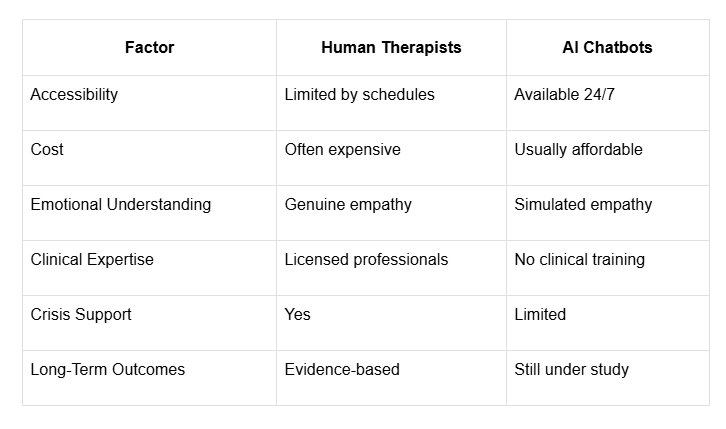
The best approach is to integrate AI with human care.
More and more, it is recommended that a balance be achieved.
AI can help users:
- Practice coping skills
- Reflect on emotions
- Stay organized
Meanwhile, therapists offer expert advice and more emotional support.
They can help to create a more complete mental health plan together.
Implications for the future of mental health care.
Explore how AI is increasingly contributing to emotional well-being.
AI is likely to remain a significant player in emotional health and wellness, and its potential impact is expected to grow.
It is a good tool for many people for its readiness to help and help practically.
Innovation and safety go hand in hand.
With adoption on the rise, developers need to embrace technology without compromising on psychological safety.
Systems will be needed that make user health, and not engagement numbers, the primary focus.
Users: These are the main takeaways from the tutorial.
For users:
- Use AI as an aid, NOT a substitute for therapy.
- Have a balanced relationship with others emotionally.
- If necessary, consult a professional for assistance.
For developers:
- Build evidence-based systems.
- Incorporate safety mechanisms.
- Don’t foster emotional neediness.
FAQs
Common Questions
AI chatbots can be beneficial for self-reflection, coping strategies, and emotional support. They should be used responsibly and not as a substitute for therapy.
No. AI chatbots are not diagnostic or therapeutic, and cannot replace the role of a licensed professional who offers diagnosis, treatment planning, and crisis response.
Emotional dependence is a scenario where users become too dependent on AI for comfort, reassurance, and companionship, thus diminishing healthy human interactions.
The risks include emotional dependency, misinformation, not seeking professional treatment, overreliance, and unhealthy attachment.
Make sure to use AI as a complement, set appropriate boundaries, ask for professional assistance if needed, and remember to use face-to-face relationships and support.
Conclusion
AI Chatbots for Mental Health is a transformative advancement in the field of digital wellness and emotional support. These tools provide access that is both easy to use, practical and helpful, and can help you cope and reduce anxiety during your everyday life.
But new research shows a cautionary note: AI is best suited as a functional aid, not as a companion. The AI Bond Paradox illustrates how while goal-directed interactions may have positive results, an emotional bond may lead to greater risks of dependence, isolation, and exacerbation of mental health symptoms.
The potential of AI in mental health support is not to replace the role of mental health professionals, but to synergize with their expertise. With the right technological advancements and evidence-based protections and healthy boundaries, AI can be a powerful ally in fostering emotional health and well-being while maintaining the indescribable power of human connection.
Source: Futurism
Share :